Knee Joint Arthroscopy
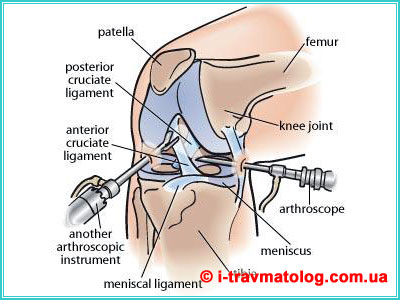
Knee joint arthroscopy - is a modern, minimally invasive surgical procedure that allows the orthopedic surgeon to diagnose and treat pathological conditions of the internal structures of the joint through several small punctures (portals). It significantly reduces the duration of postoperative recovery and minimizes trauma compared to traditional open surgical procedures (arthrotomy).

Indications for Knee Arthroscopy:
- blocks in the knee joint;
- meniscus injury;
- knee instability, cruciate ligament injury;
- mediopatellar plica syndrome;
- synovitis of the knee joint;
- limited knee function;
- chondromatosis of the knee joint.
1. What is Arthroscopy?
The term itself derives from the Greek words arthron
(joint) and skopein
(to look at). It is a technique whereby a specialized optical instrument - the arthroscope - is inserted into the joint cavity.
The Operative Procedure:
- Access: The surgeon creates 2-3 small punctures (typically about 5 mm) in the knee region.
- Arthroscope Insertion: The arthroscope - a thin tube equipped with a miniature video camera and a cold light source - is implanted through one portal.
- Visualization: The camera transmits a magnified (40-60 times) and highly accurate image of the joint's internal structure to a monitor. This allows the surgeon to meticulously inspect the articular cartilage, menisci, and ligamentous apparatus.
- Surgical Manipulation: Fine endoscopic instruments are introduced through the other portals to perform the necessary therapeutic actions.
2. Indications for the Procedure
Arthroscopy is utilized both for diagnostic verification and for the therapy of a wide range of knee joint injuries and diseases (indications):
- Meniscal Lesions: Tear, fraying, or resection (removal) of a meniscal cyst.
- Ligamentous Injuries: Plasty (reconstruction) of the anterior or posterior cruciate ligament (ACL/PCL).
- Articular Cartilage Damage: Treatment of chondromalacia, removal of fragments of damaged cartilage.
- Intra-articular Loose Bodies: Removal of fragments (chondral or osseous).
- Synovial Membrane Pathologies: Debridement in arthritis, synovitis, resection of hypertrophic plicae.
- Patellar Instability: Surgical interventions for the stabilization of the patella.
- Diagnostic Purposes: In cases where non-invasive methods (MRI, CT) do not allow for a definitive diagnosis.
3. Advantages of Arthroscopy
The minimally invasive approach provides the following clinical benefits:
- Reduced soft tissue trauma to surrounding tissues.
- Significant decrease in postoperative pain syndrome.
- Shortened healing times and minimal hospital stay.
- Superior cosmetic outcome (absence of large scars).
- Reduced risk of postoperative complications (including infection).
4. Rehabilitation Following Arthroscopy
The success of the operative procedure largely depends on comprehensive and timely recovery. The rehabilitation process commences almost immediately after the manipulation and proceeds in several phases:
Early Postoperative Period (1-7 days):
- Rest and Cryotherapy: Restriction of axial loading, local application of cold for the reduction of swelling (edema) and pain.
- Compression: Use of an elastic bandage or compression stocking for the prophylaxis of thromboembolic complications.
- Movement: Passive and moderate active exercises to maintain muscle tone and initiate the restoration of the range of motion (flexion/extension) - under medical supervision.
Functional Period (2-6 weeks):
- Gradual discontinuation of auxiliary support devices (crutches), subject to physician's approval.
- Increase in the intensity of therapeutic physical culture (Physiotherapy/PT), aimed at strengthening the muscles of the thigh and calf.
- Restoration of the full range of motion in the joint.
Sports Period (6 weeks and beyond):
- Return to customary daily activities.
- Progressive incorporation of strength training and proprioception (balance) exercises.
- Resumption of light sporting activities (swimming, stationary cycling).
Attention: The duration of full functional recovery is critically dependent on the extent of the surgical intervention. For instance, following arthroscopic meniscal resection, return to sports may be possible within 1-2 months, whereas after cruciate ligament plasty, this period may range from 6-9 months.
Crucial: All phases of rehabilitation must be conducted under the strict supervision of the treating physician and a specialist in physical therapy (rehabilitator)!